
Learn 7 ways to make moving trailers around your property safer and easier, from checking equipment capacity to clearing routes and maneuvering carefully.
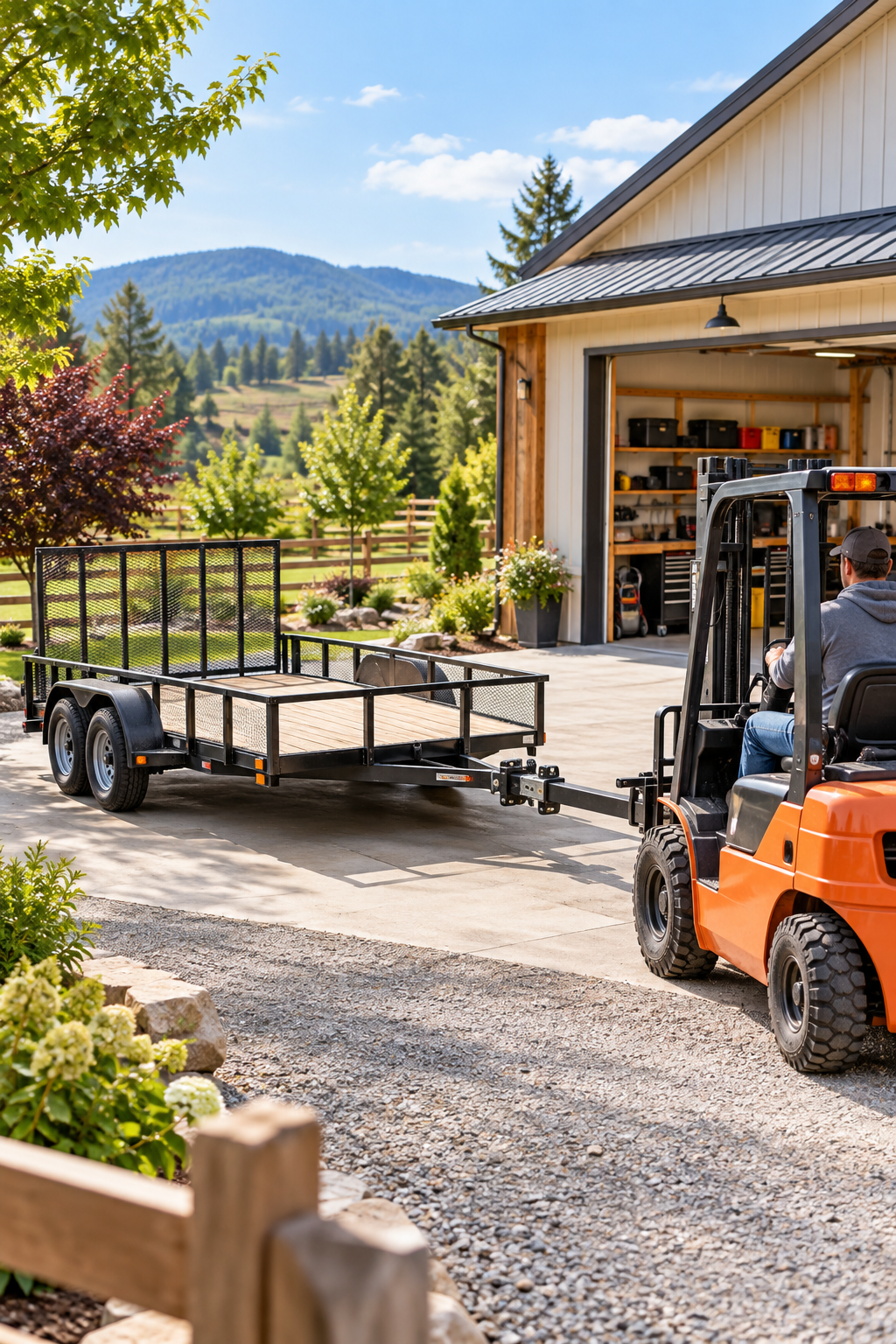
Moving a trailer around a property can be challenging when space is limited. Utility trailers, RVs, equipment trailers, and other towable units often need to be repositioned through narrow driveways, crowded garages, or tight work areas where a full-size tow vehicle may be difficult to maneuver.
For properties, workshops, or yards that already use a forklift, a specialized trailer-moving attachment can provide a practical way to handle short-distance moves. Safe operation, however, depends on matching the equipment to the trailer, staying within rated limits, and preparing the route before movement begins.
1. Match the Trailer Mover to the Type of Trailer
Trailers use different hitch configurations, so the moving equipment must match the connection point. A bumper-hitch utility trailer requires a different setup from a gooseneck or fifth-wheel trailer.
Before moving a trailer, identify its hitch type, weight, and intended connection method. These details help determine whether the forklift and attachment are appropriate for the job.
On properties where a forklift is already available, purpose-built forklift trailer movers can help reposition compatible trailers without requiring a separate tow vehicle for every short move.
This can be useful in yards, workshops, storage areas, and large garages where trailers are moved frequently or where a pickup truck has limited room to turn. The attachment, forklift, and trailer must all be compatible and used within their specified limits.
2. Choose Equipment That Connects Securely to the Forklift
The connection between the forklift, attachment, and trailer should be secure before movement begins. Improvised methods can allow components to shift or behave unpredictably, making the trailer harder to control.
A purpose-built attachment should be mounted according to its design, whether it connects to the forks or another approved mounting point. The hitch must also match the trailer and be fully seated.
Inspect the setup before each move. Check for loose hardware, worn hitch components, damaged parts, or anything that could interfere with a secure connection.
Once the attachment and trailer are properly connected, the operator can maintain better control during steering and positioning.
3. Check Capacity Before Moving Any Trailer
Forklift capacity should be verified before a trailer is moved. Adding an attachment changes the load the machine must carry, while the trailer applies weight through its tongue, kingpin, or other connection point.
Operators should check the forklift's rated capacity, the attachment's limits, and the trailer's tongue or pin weight. Load position also matters because weight extending farther from the forklift can affect balance differently from a compact load carried closer to the mast.
Manufacturer specifications, data plates, and attachment ratings should guide the decision. If the relevant weight limits cannot be confirmed, the trailer should not be moved until the equipment's capabilities are clear.
4. Account for Stability, Visibility, and Operator Training
Attachments can affect a forklift's center of gravity, capacity, visibility, and handling. A trailer also increases the overall footprint of the equipment, which changes how much space is needed to turn and maneuver safely.
Recognized forklift attachment safety considerations explain why attachments need to be evaluated as part of the forklift's operating configuration.
The operator should have a clear view of the travel path and understand how the trailer responds to steering. If the trailer blocks visibility in a critical area, the route may need to be changed or a spotter may be appropriate.
Operators should also be trained and familiar with the attachment they are using. Knowing how the combined setup behaves helps reduce unnecessary corrections in confined spaces.
5. Clear the Route Before Repositioning a Trailer
Inspect the full travel path before moving the trailer. Remove or account for parked vehicles, tools, equipment, low branches, gates, posts, garage doors, and other obstacles that may limit clearance.
Pay particular attention to turns. A trailer does not always follow the exact path of the forklift. Its wheels can track inside the turn while the rear of the trailer swings outward, creating potential clearance problems near walls, fencing, storage racks, or nearby vehicles.
Ground conditions should also be checked. Loose gravel, mud, slopes, potholes, and uneven pavement can reduce traction or make movement less predictable.
Keep pedestrians away from the operating area until the maneuver is complete. A clear route gives the operator enough space to make controlled movements without relying on abrupt corrections.
6. Keep the Garage or Work Area Clear for Easier Maneuvering
Garages, workshops, and storage areas can become crowded with tools, shelving, project materials, landscaping equipment, and seasonal items. When these items spread into travel paths, they reduce turning room and restrict visibility.
If trailers regularly move through the area, establish clear lanes and keep loose equipment away from them. Taking time to organize your garage can help preserve the space needed for trailer positioning.
Wall storage and shelving can keep smaller items away from the floor, while larger equipment can be assigned fixed parking locations. Marking a consistent trailer storage position can also make future moves easier by providing a predictable approach angle and destination.
7. Use Slow, Deliberate Movements in Tight Spaces
Trailer positioning requires precise control, particularly in narrow areas. Sudden acceleration, hard braking, and sharp steering can make the trailer more difficult to place accurately.
Move at a controlled speed and use gradual steering whenever space allows. Watch the trailer's wheels, rear corners, hitch connection, and surrounding clearance throughout the maneuver.
If visibility becomes inadequate, stop and reassess before continuing. In particularly tight areas, several small corrections may be safer and more accurate than trying to complete the maneuver in a single turn.
Careful positioning gives the operator more time to respond to changing clearance and helps keep the trailer under control from start to finish.
Make Trailer Movement a Planned Process
Safe trailer movement begins with the right equipment and a clear understanding of its limits. The forklift, attachment, and trailer should be compatible, properly connected, and operated within their rated capacities.
The surrounding environment matters as well. A clear route, adequate maneuvering room, suitable ground conditions, and controlled operation can make repeated trailer positioning more predictable.
For properties where trailers are moved regularly, planning each move before the forklift starts can reduce unnecessary complications and make better use of the available space.


As Seen on TikTok
Come behind the scenes of our farmhouse build, decor projects, and cozy everyday life. Tap a video to watch, then follow @nikkisplate on TikTok for more.
Watch this video on TikTok
Watch this video on TikTok
Watch this video on TikTok





Leave a Reply