
Learn how to choose a kitchen faucet that lasts, from durable materials and finishes to sprayer styles, water efficiency, installation, and care.
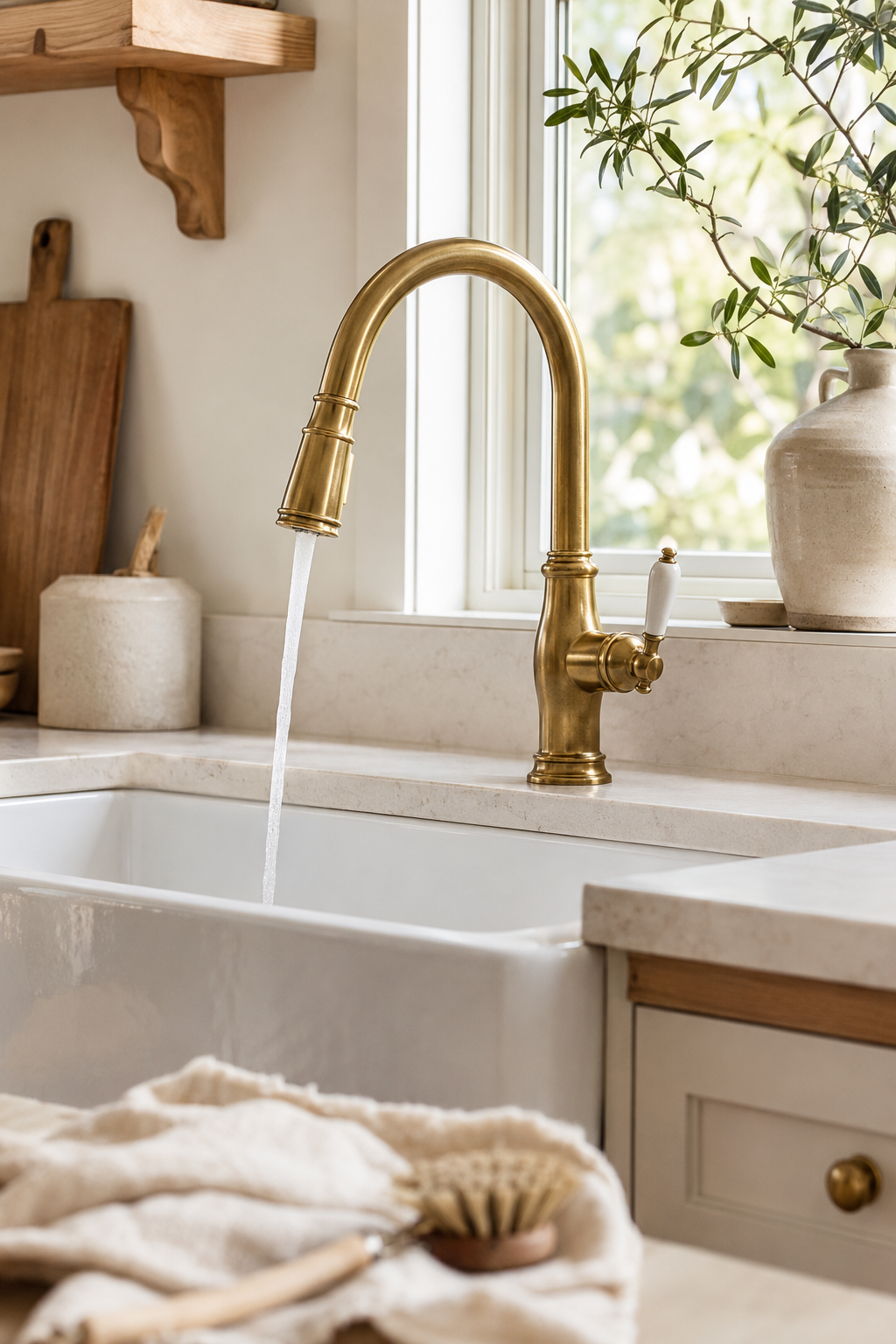
If you're wondering how to choose a kitchen faucet, it helps to look beyond the finish and consider how it will function in your everyday life. After designing the kitchen in our new home, I realized just how much those practical details matter. A faucet might seem like a small finishing touch, but it's one of the hardest-working features in the entire kitchen-from rinsing produce and filling large pots to washing hands and cleaning up after meals.
With so many styles, materials and features available, shopping at a hardware store, plumbing showroom or online faucet warehouse can quickly feel overwhelming. Should you choose a pull-down or pull-out sprayer? Is solid brass worth the investment? Which finishes are easiest to maintain?
In this guide, I'm breaking down everything you need to consider when choosing a long-lasting kitchen faucet, including configurations, materials, finishes, everyday functionality, water efficiency and maintenance. You don't need to be a plumbing expert-just a clear idea of what will work best for your kitchen and family.
Understanding Basic Faucet Types and Configurations
Before you get drawn in by finishes or features, take a moment to confirm what your sink can actually accommodate. Most modern kitchen sinks are drilled for one to three holes, and your faucet must match that configuration precisely.
Common faucet types include:
- Single-handle faucets - control both temperature and flow with one lever; intuitive and space-efficient.
- Double-handle faucets - separate controls for hot and cold; suit traditional kitchen aesthetics well.
- Pull-down sprayers - the spout head retracts downward; ideal for deeper sinks.
- Pull-out sprayers - the head pulls forward toward you; better suited to smaller or shallower sinks.
- Fixed spout designs - simpler, with fewer moving parts and lower maintenance demands overall.
Always verify your sink's hole configuration before you buy. If you want to add a side sprayer or soap dispenser, those require additional holes too, so it pays to plan ahead.
Materials and Finishes: What Really Affects Durability
Not all faucets are built to last equally. More than anything else, the body material determines how long a faucet will hold up in real-world use.
Solid brass remains a dependable choice thanks to its natural corrosiona resistance and structural integrity. Zinc alloy and plastic components are lighter and cheaper, but they tend to degrade faster-particularly in homes with hard water. Internal components matter just as much as the outer shell. Faucets fitted with a ceramic disc cartridge significantly outperform those relying on older rubber washers, since ceramic discs resist wear and are far less prone to the dripping failures that plague aging faucets. When in doubt, check the product specification sheet directly rather than judging quality by appearance alone.
Key Takeaway: Prioritize solid metal construction and quality internal cartridges over purely decorative finishes.
As for surface finishes, chrome, brushed nickel, and matte black each behave differently day to day. Chrome cleans up easily but shows water spots almost immediately; matte finishes hide fingerprints well but may require gentler cleaning products to avoid surface damage over time.
Ergonomics and Everyday Use
Before settling on a faucet, think honestly about how you actually use your sink. Spout height and reach determine whether large pots fit comfortably under the stream. Handle placement-front-mounted, side-mounted, or top-mounted-can make a meaningful difference for children, older adults, or anyone with limited hand strength.
A few questions worth asking yourself:
- Do you regularly wash large cookware that needs real clearance beneath the spout?
- Would a pause button on the sprayer head make your routine noticeably easier?
- Is one-handed operation something that matters for how you move around the kitchen?
- The answers will steer you toward the right configuration faster than any spec sheet will.
Water Efficiency and Safety Considerations
A faucet's flow rate, measured in gallons per minute, has a direct impact on both water usage and utility costs over time. A well-designed aerator-the small mesh insert at the tip of the spout-shapes the water stream, reduces splashing, and can meaningfully cut consumption without sacrificing usable pressure. It's a small detail that earns its keep.
For households with young children or elderly users, faucets with anti-scald protection are worth seeking out; they limit how far the handle can rotate toward the hot side, adding a simple but effective layer of safety. Designs with fewer surface crevices are also easier to keep clean and hygienic through regular maintenance.
Key Takeaway: Look for faucets that balance adequate flow with responsible water use and basic safety features.
Installation Practicalities and Long-Term Maintenance
Before purchasing, check clearance behind and above the faucet-a handle that collides with the backsplash or a spout that won't clear your tallest pot are common, entirely avoidable frustrations. If the installation seems more complex than expected, consulting a licensed plumber is always a sound call.
For ongoing maintenance, a few simple habits go a long way:
- Clean the faucet surface regularly using finish-appropriate products; steer clear of abrasive scrubbers.
- Periodically remove and rinse the aerator to clear any mineral buildup.
- Check under the sink occasionally for minor drips-they're far easier to address early than after the fact.
- Keep the manufacturer's installation guide somewhere accessible for future reference.
Proper sealing around the base and correctly tightened supply lines are essential for leak prevention right from day one.
Making a Balanced Choice
Whether you're comparing options at a local plumbing supply shop or working through a large online collection, a simple decision framework can prevent the kind of fatigue that leads to regrettable impulse buys.
Decision Checklist:
- Does the faucet match my sink's hole configuration?
- Is the body material solid brass or high-quality stainless steel?
- Does it use a ceramic disc cartridge?
- Is the spout height and reach appropriate for my cookware?
- Does it include an aerator and any needed safety features?
Aim for a faucet where function, durability, and comfort are genuinely in balance. No single factor-price, appearance, or brand name-should carry the whole decision. Cross-reference product specifications, seek professional input when needed, and lean on independent reviews to round out your research.
Bringing It All Together for a Long-Lasting Upgrade
Choosing a kitchen faucet thoughtfully-understanding the types available, prioritizing durable materials, thinking through ergonomics, and planning for maintenance-can save years of frustration from leaks, awkward controls, and premature replacements. Take stock of what your current faucet gets wrong, apply the framework above, and shop with clarity rather than guesswork.
A well-chosen kitchen faucet is an investment in everyday comfort, reliability, and safety-a modest upgrade that quietly improves one of the most-used spaces in your home, day after day.
Until next time,



As Seen on TikTok
Come behind the scenes of our farmhouse build, decor projects, and cozy everyday life. Tap a video to watch, then follow @nikkisplate on TikTok for more.
Watch this video on TikTok
Watch this video on TikTok
Watch this video on TikTok


Leave a Reply